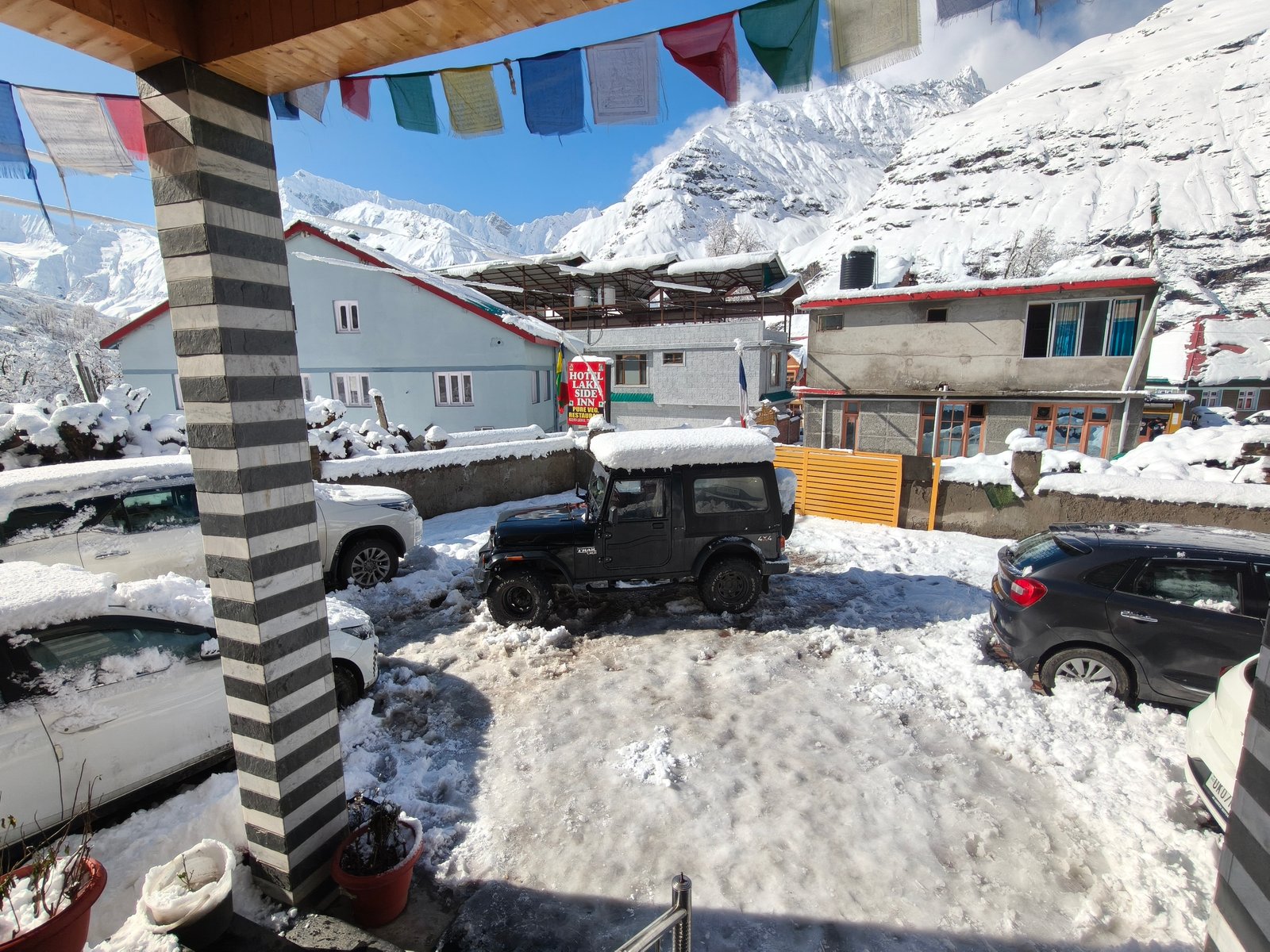
Sissu sits at about 3,100 m in the Lahaul valley, so its weather swings hard with the seasons: deep-frozen winters near −12°C, mild 20–22°C summer days, and a dry, sunny monsoon thanks to the Himalayan rain shadow. Snow falls roughly November through March.
Quick answer
Sissu’s temperature ranges from roughly −12°C on a cold January night to about 22°C on a warm July afternoon. Summer (May–September) is pleasant and dry, with daytime highs of 15–22°C and cool nights. Winter (December–February) is genuinely cold and snowbound, with highs hovering near or just below freezing and lows dropping to −9°C to −12°C. Because Lahaul sits in the rain shadow behind the Pir Panjal range, Sissu stays largely dry even during the Indian monsoon — it gets a fraction of the rain that Manali, just across the Atal Tunnel, receives. All figures below are seasonal averages; at this altitude the actual weather on any given day can change within hours.
Sissu climate overview
Sissu is a high-altitude cold-desert village on the floor of the Chandra valley in Lahaul & Spiti, Himachal Pradesh. Three things shape its climate, and once you understand them the month-by-month table makes sense:
- Altitude (~3,100 m). Air is thin and the sun is strong, so days can feel warm in direct sunlight while shade and nights stay cold year-round. Even in midsummer, nights rarely climb far above 8–11°C.
- The Pir Panjal rain shadow. The high Pir Panjal range wrings most of the moisture out of monsoon clouds before they cross into Lahaul. So while Manali is lush and rainy from July to September, Sissu stays comparatively dry and sunny — one of the few places in the Indian Himalaya you can reliably escape the monsoon.
- Heavy winter snow. The same valley that misses the summer rain catches deep winter snow from western disturbances. From late November into March, Sissu can see significant snowfall, and the surrounding high passes (Rohtang, Kunzum, Baralacha) close completely.
The practical upshot: Sissu has a short, glorious warm season (roughly May to early October) framed by a long, frozen winter. The Atal Tunnel, opened in 2020, now keeps Sissu reachable from Manali for most of the year — a major change from the old days when the Rohtang Pass cut the valley off for six months. For a season-by-season recommendation rather than raw data, see our best time to visit Sissu guide.
Month-by-month weather table
Approximate monthly averages for Sissu at ~3,100 m. Temperatures are typical daytime highs and overnight lows; expect day-to-day variation of several degrees either way.
| Month | Avg High °C | Avg Low °C | Snow likelihood | Road / Atal Tunnel status | Crowd level |
|---|---|---|---|---|---|
| January | ~−2 | ~−12 | Very high | Tunnel often open; Sissu road may close after heavy snow | Very low |
| February | ~0 | ~−10 | Very high | Tunnel usually open; snow clearing ongoing | Very low |
| March | ~5 | ~−4 | High | Tunnel open; roads improving as snow recedes | Low |
| April | ~10 | ~0 | Moderate | Tunnel open; most local roads clear | Rising |
| May | ~15 | ~5 | Low (lingering) | Tunnel open; high passes begin to open | High (peak) |
| June | ~20 | ~8 | Very low | Tunnel open; Kunzum/Baralacha typically open | High (peak) |
| July | ~22 | ~11 | None | Tunnel open; dry roads, watch for occasional slides | High |
| August | ~21 | ~11 | None | Tunnel open; generally clear in the rain shadow | High |
| September | ~18 | ~7 | None | Tunnel open; excellent driving conditions | Moderate |
| October | ~12 | ~2 | Low (late month) | Tunnel open; high passes start closing | Moderate |
| November | ~6 | ~−3 | Moderate–high | Tunnel open; first snow possible on Sissu road | Low |
| December | ~2 | ~−9 | High | Tunnel usually open; snow can shut local road | Low (snow seekers) |
Winter (Dec–Feb)
This is Sissu’s deep-freeze. Daytime highs sit between roughly +2°C in December and around 0°C in the heart of winter, while nights plunge to −9°C to −12°C. January is the coldest month. Snow is frequent and can be heavy: the village turns white, the waterfall freezes into ice columns, and Sissu Lake often freezes over. The Atal Tunnel usually stays open, so Sissu is reachable from Manali even in midwinter — but the short road link from the tunnel exit down to Sissu can be closed temporarily after a big snowfall while crews clear it.
If you’re chasing snow, this is the season, but come prepared for serious cold and the chance of a delay. Our dedicated Sissu in December guide covers the first month of full winter in detail.
Spring (Mar–Apr)
Spring is the thaw. March still feels wintry — highs near 5°C, nights around −4°C, and fresh snow still possible — but by April the valley is warming fast, with highs around 10°C and lows near freezing. Snow on the valley floor recedes through April, though the surrounding peaks stay white and many high passes remain shut. It’s a quieter, in-between season: fewer crowds, patchy snow for photos, and crisp, clear air. Good for travellers who want winter scenery without the deepest cold.
Summer (May–Jun)
May and June are Sissu’s peak season, and for good reason. Days are pleasant — highs of about 15°C in May rising to around 20°C in June — with cool, fresh nights (5–8°C). Lingering snow gives way to green meadows, the waterfall runs full from snowmelt, and the high passes to Chandratal and Spiti open up. This is the busiest, most popular window, so rooms fill early. Read our month guides for Sissu in May for the shoulder-into-peak transition.
Monsoon (Jul–Sep)
While the rest of Himachal is drenched, Sissu enjoys one of its best-kept secrets: a largely dry monsoon. Sitting in the Pir Panjal rain shadow, Lahaul gets only a fraction of the rainfall that Manali sees from July to September. Days are mild — highs of 18–22°C, the warmest of the year — and nights stay around 7–11°C. July is typically the warmest month. Skies are often clear and the landscape stays green and lush. The main caution is on the Manali side of the tunnel, where heavy rain can trigger landslides on the approach roads, so check conditions before driving up.
Autumn (Oct–Nov)
Autumn cools quickly. October is crisp and clear — highs around 12°C, lows near 2°C — with superb visibility and golden valley colours, making it one of the most photogenic months. By November the chill deepens: highs drop to about 6°C, nights fall below freezing (~−3°C), and the first snows of the season can arrive on the Sissu road. The high passes begin to close. It’s a beautiful, quiet time to visit before winter fully sets in.
What to wear by season
Sissu’s altitude means you should always pack layers, even in summer, because nights are cold year-round. A quick guide:
- Winter (Dec–Feb): Heavy down jacket, thermals, woollen layers, insulated waterproof boots, gloves, woollen cap, and good socks. Treat it like serious sub-zero conditions.
- Spring & Autumn (Mar–Apr, Oct–Nov): Warm fleece or down jacket, thermals for nights, and a windproof outer layer. Daytime can be mild in the sun, but mornings and evenings bite.
- Summer & Monsoon (May–Sep): Light layers for the day, a warm jacket or fleece for evenings, sunglasses, high-SPF sunscreen (the high-altitude sun is fierce), and a light raincoat just in case.
For a full, season-by-season checklist of clothing, footwear and medicines, see what to pack for Sissu.
Frequently Asked Questions
What is the temperature in Sissu?
Sissu’s temperature depends heavily on the season. Summer (May–September) daytime highs run about 15–22°C with cool nights of 5–11°C. Winter (December–February) is cold, with highs near or below freezing and overnight lows of roughly −9°C to −12°C. The warmest month is July (~22°C average high) and the coldest is January.
When does it snow in Sissu?
Snow in Sissu typically falls from late November through March, with the heaviest snowfall usually in January and February. Light or lingering snow is possible into April and again from late October. Mid-summer (June–September) sees effectively no snow at the village level.
How cold does Sissu get?
At around 3,100 m, Sissu gets genuinely cold in winter. Average January lows are about −12°C, and on the coldest nights it can drop further. Even daytime highs in midwinter hover near or just below 0°C. Pack for serious sub-zero conditions if you visit between December and February.
Does it rain in Sissu?
Sissu gets relatively little rain because Lahaul lies in the rain shadow of the Pir Panjal range. During the Indian monsoon (July–September), when Manali is wet, Sissu stays largely dry and sunny — it receives only a fraction of Manali’s rainfall. The bigger weather risk in monsoon is landslides on the Manali-side approach roads, not rain in Sissu itself.
What is the weather in Sissu in summer?
Summer in Sissu (May–September) is mild and pleasant, with daytime highs of about 15–22°C and cool nights of 5–11°C. Skies are often clear, the waterfall runs full, and the valley is green. Nights remain cold even in peak summer, so always carry a warm layer.
What is the coldest month in Sissu?
January is the coldest month in Sissu, with average daytime highs around −2°C and overnight lows near −12°C. February is nearly as cold and tends to bring the heaviest snowfall along with January.
Make Sissu your home for a few days
Cosy mountain-view rooms, 24×7 hot water and a pure-veg kitchen — a 2-minute walk from Sissu Lake. Book direct for our best rate.