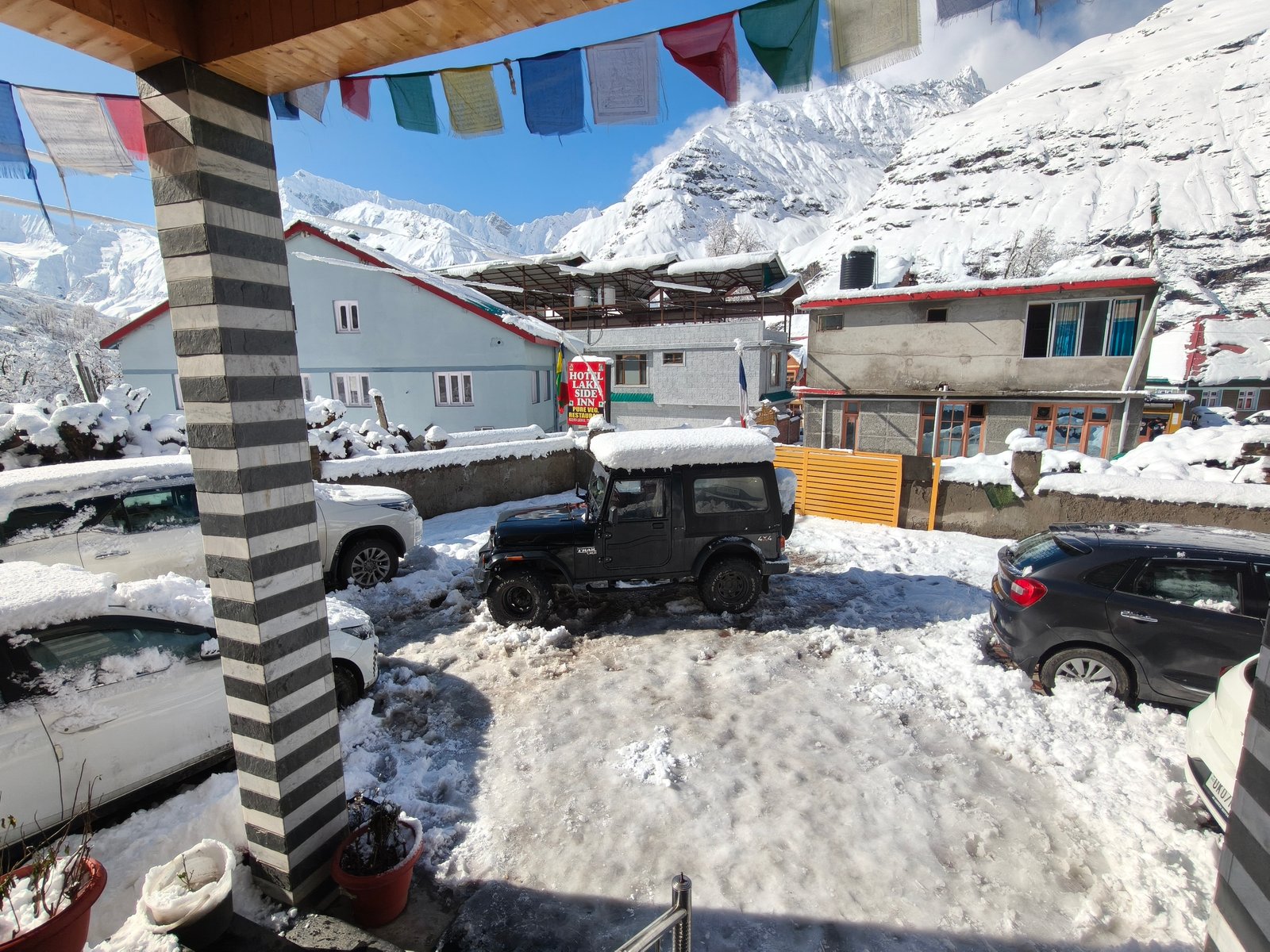
Kardang Monastery is one of the largest and most important Drukpa Kagyu Buddhist monasteries in the Lahaul valley, sitting on the hillside across the Bhaga river from Keylong, at roughly 3,500 m. From Hotel Lake Side Inn in Sissu it is about a 30–35 km drive up-valley — an easy half-day trip. Once the seat of Lahaul’s Buddhist life, it holds a huge prayer wheel, old thangkas and scriptures, the relics of its revered lama Kunga Rinpoche, and a sweeping view back over Keylong and the confluence country.
What Kardang Monastery is
Kardang (also spelt Kardong or Kardang Gompa) is a working Buddhist monastery of the Drukpa Kagyu school — the same lineage that shaped much of Himalayan Buddhism from Ladakh to Bhutan. For centuries it was the most significant religious institution in Lahaul, and it remains an active place of worship with resident monks and nuns rather than a museum. The village of Kardang below it gave the monastery its name.
What sets it apart from the smaller shrines dotted around the valley is scale and standing. This is not a roadside chapel; it is a substantial complex of prayer halls, living quarters and a library, built into a steep slope with the Bhaga river running far below and Keylong visible across the water. If you only have time for one monastery on a trip to Lahaul, this is the one most locals will point you toward. It pairs naturally with the other sights on our places to visit near Sissu circuit.
History & the Drukpa lineage
Kardang’s roots reach back many centuries — local tradition places an early foundation around the twelfth century — but the monastery as it stands owes its revival to the early twentieth century, when the lama Kunga Rinpoche restored and re-energised it. His relics are preserved here, and he is remembered as the figure who brought the gompa back to prominence after a long decline.
The Drukpa Kagyu presence explains much of what you see: the emphasis on meditation lineage, the particular deities in the murals, and the community of both monks and nuns who have historically been attached to the monastery. Because Lahaul sits on an old cultural bridge between the Indian plains and Tibetan Buddhism, Kardang embodies that meeting — a Himalayan Buddhist institution on the Indian side of the mountains, shaped by Tibetan traditions. It is a useful complement to the older animist and Hindu-Buddhist threads you meet at the Raja Gyephang temple near Sissu.
What to see inside
Give yourself an unhurried hour. The things guests remember most:
- The great prayer wheel. Kardang is known for a very large cylindrical prayer wheel packed with millions of printed mantras — turning it, clockwise, is the traditional act of merit and a quiet highlight of any visit.
- Relics of Kunga Rinpoche. The revered lama’s relics are enshrined here, a focus of devotion for the community.
- Thangkas, murals & statues. Painted scrolls, wall murals of Buddhist deities and old statues fill the prayer halls; the artwork rewards a slow look.
- The library. The monastery holds a collection of Buddhist scriptures, including texts in the old Bhotia script — a reminder that this was a centre of learning, not just prayer.
- Musical instruments & ritual objects. Old horns, drums and ceremonial pieces used in the monastery’s rituals are often on display.
Because it is a living monastery, opening of individual halls can depend on whether a monk is available to unlock them, so patience and a friendly manner go a long way.
The setting & the views
Half the reward is simply being up there. Kardang sits high on the south bank of the Bhaga river, looking across to Keylong on the opposite slope and out over the wide valley where the Chandra and Bhaga eventually meet at Tandi. In clear weather the panorama of terraced fields, the river far below and the snow ridges beyond is superb — and noticeably grander than the enclosed feel of Sissu on the valley floor, because you have gained height. It is one of the best easy viewpoints in this part of Lahaul, and a fine spot for photography in the soft light of morning or late afternoon.
How to reach Kardang Monastery from Sissu
The monastery is an easy up-valley run from the hotel. The route in brief:
- Sissu to Keylong (~30 km). Follow the valley-floor highway north-west, past Gondhla and Tandi, to Keylong — roughly an hour. Our Sissu to Keylong guide covers this leg in detail.
- Cross the Bhaga. From Keylong, a road drops to the river and climbs the far bank toward Kardang village — a further few kilometres of narrow mountain road.
- Climb to the gompa. The monastery sits above Kardang village; the last stretch is steep, and in places visitors walk the final section.
All told it is about 30–35 km and 1–1.5 hours each way from Sissu, depending on road conditions. Remember there is no petrol pump in Sissu — the last fuel is at Tandi, ~22 km along, so top up if you are low. Our travel desk can arrange a driver who knows the road; just get in touch. Many guests combine Kardang with Keylong’s market and Gondhla Fort in a single day out from their room at the hotel.
Best season & timing
Visit between May and October, when the roads are clear and the walk up is pleasant. Summer (June–September) is ideal. In deep winter the higher approach can be snowbound and tourist movement in Lahaul is sometimes restricted, so a winter visit is not reliable — confirm with us first. Aim to arrive mid-morning to early afternoon: the light is good, monks are more likely to be around to open the halls, and you leave yourself time to drive back to Sissu before the valley cools and darkens.
Visitor etiquette
This is a place of active worship, so a little care matters:
- Dress modestly — cover shoulders and knees.
- Remove your shoes before entering prayer halls, and lower your voice inside.
- Walk clockwise around shrines and stupas, and turn prayer wheels clockwise.
- Ask before photographing interiors, monks or relics; some halls do not allow photos.
- Do not touch statues, thangkas or ritual objects.
- A small donation toward the monastery’s upkeep is welcome and appreciated.
Treat the community with the same respect you would any working religious house and you will find the monks warm and welcoming.
Frequently Asked Questions
How far is Kardang Monastery from Sissu?
Kardang Monastery is about 30–35 km from Sissu — roughly 1–1.5 hours up-valley. You drive to Keylong (~30 km), then cross the Bhaga river and climb to the gompa above Kardang village. It makes a comfortable half-day trip from Hotel Lake Side Inn.
Why is Kardang Monastery important?
It is one of the largest and most important Drukpa Kagyu monasteries in Lahaul, historically the region’s spiritual centre. It holds the relics of the lama Kunga Rinpoche who revived it, a huge prayer wheel, old thangkas and a library of Buddhist scriptures.
What is the best time to visit Kardang Monastery?
May to October, with summer (June–September) ideal. The roads are clear and the walk up is pleasant. In deep winter the approach can be snowbound and tourist movement in Lahaul is sometimes restricted, so confirm conditions with the hotel before a winter visit.
Can I visit both Kardang Monastery and Keylong in one day?
Yes, easily. Kardang sits just across the river from Keylong, so most visitors combine the two — and often Gondhla Fort as well — in a single day trip from Sissu. See our places to visit near Sissu guide to plan the day.
Is there an entry fee for Kardang Monastery?
There is generally no fixed entry ticket, but a small donation toward the monastery’s upkeep is customary and appreciated. Photography inside some halls may be limited, so always ask a monk before taking photos of interiors or relics.
What should I wear and know before visiting?
Dress modestly, covering shoulders and knees. Remove your shoes before entering prayer halls, keep your voice low, walk clockwise around shrines, and turn prayer wheels clockwise. Do not touch statues or thangkas, and ask before photographing monks or interiors.
See Lahaul’s great monastery from a warm base
Stay in Sissu and reach Kardang, Keylong and Gondhla on easy day trips — mountain-view rooms, hot water and a travel desk to sort your driver. Book direct.